Chassagne-Montrachet Grand Cru: a complete terroir guide
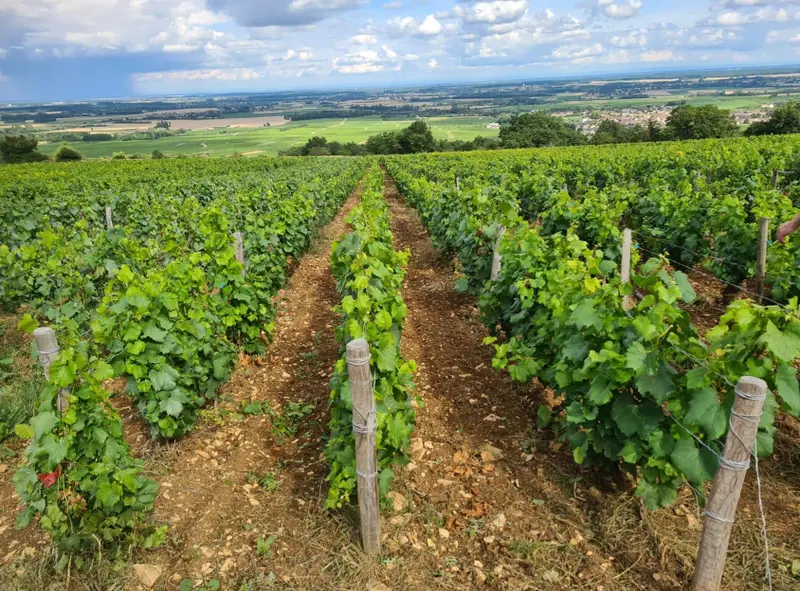
Chassagne-Montrachet is one of the most prestigious appellations in Burgundy. Lying at the southern end of the Côte de Beaune, the village produces Chardonnay white wines and Pinot Noir reds across 315 hectares of vines. Three Grands Crus are planted here, including the legendary Le Montrachet — considered by many to be the greatest dry white wine in the world. This guide explores the terroir, the soils, the climats and the characteristics that make this appellation a jewel of French viticulture.
Where is Chassagne-Montrachet located?
Chassagne-Montrachet sits between Puligny-Montrachet to the north and Santenay to the south, in the Côte-d'Or department of Bourgogne-Franche-Comté. The appellation covers mainly the commune of Chassagne-Montrachet and a small part of Remigny, near the town of Chagny.
The vines are strung between 220 and 325 metres of altitude on the eastern slope of the Côte d'Or. This exposure guarantees ideal morning sunlight, encouraging a slow and balanced ripening of the grapes. The landscape is marked by a rocky ridge of limestone, from which marble-quality stones have been extracted for Parisian monuments as celebrated as the Trocadéro and the Louvre Pyramid.
The climate is continental, with cold winters and warm summers. Annual rainfall is close to 700 mm. Spring frost is a real risk, particularly in the lower-lying parcels such as the Abbaye de Morgeot, which sits between 230 and 240 metres of altitude.
In 1878, the village of Chassagne added to its name that of its most prestigious cru — Le Montrachet, pronounced “Mon-rachet” — to become officially Chassagne-Montrachet. The appellation d'origine contrôlée was recognised by the decree of 31 July 1937.
- Altitude
- 220 – 325 m
- Surface area
- 315 hectares
- Grands Crus
- 3 (Le Montrachet, Bâtard-Montrachet, Criots-Bâtard-Montrachet)
- Premiers Crus
- 55 climats, ~145 hectares
- AOC since
- 31 July 1937
Chassagne-Montrachet terroir and soil
The geology of Chassagne-Montrachet is remarkably diverse. From the top of the slope down towards the plain, one encounters in succession Rauracian limestones, a Callovian talus with Argovian marls, and Bathonian limestones. This sequence creates a mosaic of terroirs unique in Burgundy.
Soils vary considerably from one climat — that is, a named lieu-dit with distinctive characteristics — to another. At the top of the slope, the earth is stony and limestone-rich, shallow, and perfectly suited to whites of great mineral purity. Mid-slope, clay-limestone marls dominate, giving wines of beautiful complexity. Towards the foot of the slope, soils become deeper and clayier, with a limestone bedrock closer in character to that of the Côte de Nuits.
The climat Abbaye de Morgeot, classified Premier Cru, illustrates this diversity perfectly. Its reddish clay-limestone marls, coloured by the presence of iron oxides, rest on a subsoil of Bathonian limestone debris. This combination produces wines that are at once rich, powerful and endowed with a characteristic saline minerality. Ageing potential reaches 10 to 15 years in the finest vintages.
This geological diversity explains why two parcels just a few metres apart can produce wines with very different profiles. It is the very principle behind the Burgundian notion of the “climat”, inscribed on the UNESCO World Heritage list since 2015. Discover more on our Terroir page.
Chassagne-Montrachet Grand Cru and Premier Cru vineyards
Chassagne-Montrachet is home to three Grand Cru appellations, all reserved for Chardonnay white wines.
Montrachet Grand Cru
Shared with Puligny-Montrachet, Le Montrachet covers 7.99 hectares. It yields around 47,000 bottles a year — a tiny quantity set against its worldwide renown. Planted as early as the Middle Ages, it is first mentioned in 1252, when Pierre and Arnolet de Puligny gave wines from “Mont Rachaz” to the abbey of Maizières. The name comes from the toponym “Mont Rachaz”, referring to a bald rise, a rocky outcrop where vegetation struggles to grow.
Bâtard-Montrachet Grand Cru explained
Bâtard-Montrachet, also shared with Puligny, stretches over 11.24 hectares. Criots-Bâtard-Montrachet, situated entirely within the commune of Chassagne, is the smallest at just 1.57 hectares. According to legend, the names of these crus stem from a medieval division of lands: the lord of Puligny is said to have shared his estate between the “Chevalier” (the eldest son), the “Pucelles” (the daughters) and the “Bâtard”.
Best Chassagne-Montrachet Premier Cru climats
The 55 climats classified as Premier Cru cover around 145 hectares, close to half the total surface area. Among the most celebrated: Morgeot (the largest, at 58 hectares encompassing several lieux-dits), La Maltroie, Clos Saint-Jean, En Cailleret, Les Chenevottes and Les Grandes Ruchottes. The Abbaye de Morgeot specifically covers 8.56 hectares, taking in the lieux-dits Morgeot and La Chapelle.
Chassagne-Montrachet white vs red wine
Contrary to popular belief, Chassagne-Montrachet produces both white and red wines. Whites dominate, with 223 hectares of Chardonnay (locally known as “Aubaine”), against 86 hectares of Pinot Noir (called “Pinot Noirien”) for the reds.
Chassagne-Montrachet whites stand out for their power and their richness. The nose reveals complex aromas of almond, acacia honey, white flowers (hawthorn, linden) and stone fruit (white peach, apricot). On the palate, opulence and weight are balanced by a remarkable liveliness. Premiers Crus such as the Abbaye de Morgeot add a saline, mineral dimension that is the signature of this terroir. Ageing potential ranges from 3 to 15 years depending on the level of appellation.
The reds, from Pinot Noir, account for around one third of production. The colour is deep purple-red. The nose offers aromas of cherries, morello cherries, strawberries and spice. The palate is concentrated, powerful, with firm tannins. Ageing potential runs from 5 to 8 years. Discover our estate wines.
How Chassagne-Montrachet is made and aged
Harvest is traditionally done by hand in Chassagne-Montrachet. Yields are controlled by the AOC specifications: 45 hectolitres per hectare for village whites, 55 hl/ha for Premier Cru whites, and 40 hl/ha for village reds.
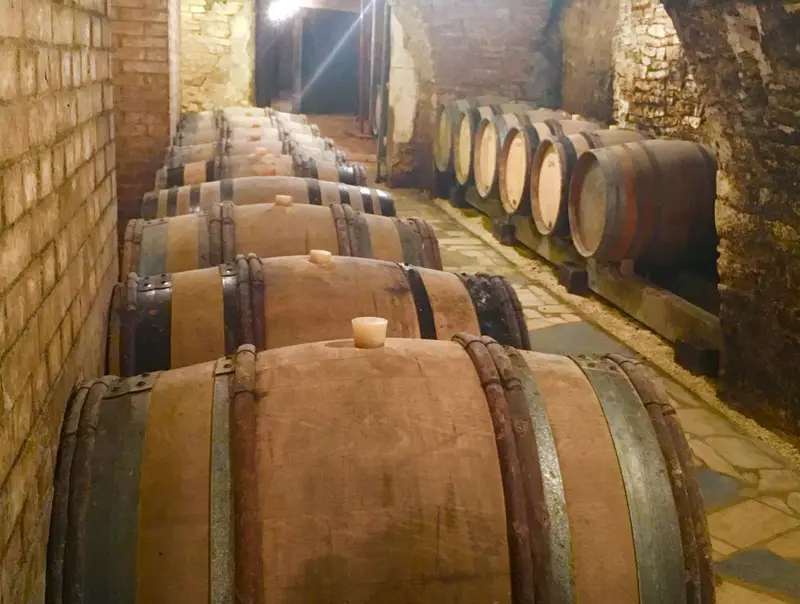
For the whites, pressing is gentle — most often pneumatic. Alcoholic fermentation takes place in French oak barrels, with 20 to 40% new wood. Malolactic fermentation is also carried out in barrel, followed by ageing on fine lees for 12 to 18 months. The lees bring richness, aromatic complexity and that creamy texture which defines the great whites of Chassagne.
For the reds, after full destemming and a cold pre-fermentation maceration (5 to 7 days at 12°C), fermentation lasts 15 to 20 days. Ageing in barrel runs for 12 to 16 months.
How to serve Chassagne-Montrachet: temperature and food pairings
The whites are served between 12 and 14°C. Their opulence accompanies fine white meats (suprema of Bresse poultry, veal in cream sauce), shellfish (lobster, spiny lobster) and foie gras. Premiers Crus pair particularly well with spiced exotic cuisines (curry, tandoori). See our guide to food and wine pairings.
The reds are served between 14 and 16°C. They accompany grilled lamb, pork and curried poultry. The Premier Cru reds deserve feathered game.
Frequently asked questions
What is the difference between Chassagne-Montrachet and a Grand Cru?
Chassagne-Montrachet is a village appellation that includes village, Premier Cru and Grand Cru wines. The three Grands Crus are specific parcels producing exclusively Chardonnay white wines at the very top of the qualitative hierarchy.
How many Premiers Crus are there in Chassagne-Montrachet?
55 climats classified as Premier Cru cover around 145 hectares. Among the most famous: Morgeot, La Maltroie, Clos Saint-Jean, En Cailleret and Les Grandes Ruchottes.
Does Chassagne-Montrachet produce red wines?
Yes. Around 86 hectares of Pinot Noir produce powerful, tannic red wines, accounting for roughly one third of total production.
What is the average price of a Chassagne-Montrachet?
Village white: €30-60. Premier Cru: €50-150. Grands Crus: above €300, with Le Montrachet reaching several thousand euros.
How long should a white Chassagne-Montrachet be cellared?
Village: 3-7 years. Premier Cru: 8-15 years. Grands Crus: 10-20 years, or even longer for the greatest vintages.
Sources
Taste Chassagne-Montrachet
→ Our Chassagne-Montrachet 1er Cru 2018 → Discover our terroir → Book a tasting