
Abbaye de Morgeot: the story of an exceptional terroir
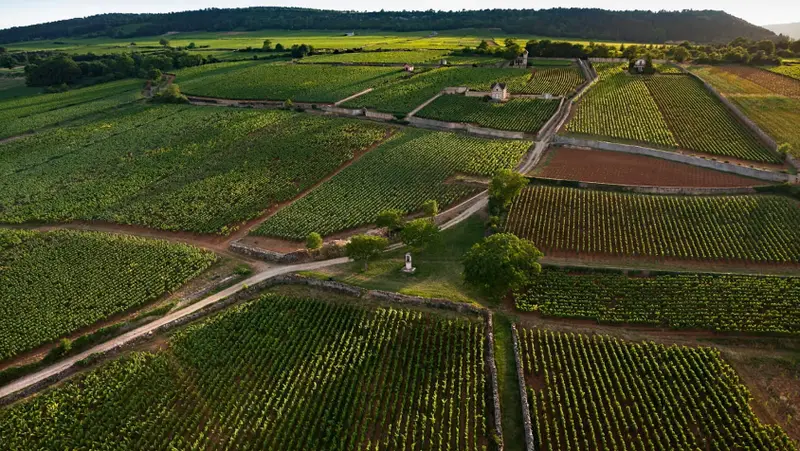
The Abbaye de Morgeot embodies nine centuries of winegrowing tradition at the heart of Chassagne-Montrachet. This climat, classified as Premier Cru and one of the largest and most renowned of the appellation, produces white and red wines of singular character, marked by the richness of the soil and the memory of the Cistercian monks who shaped it. This article retraces the history of the place, describes its terroir and explains what makes its wines so distinctive.
From Cistercian monks to today's winegrowers
Around 1150, the Cistercian monks of the abbey of Maizières established a dependency — a priory — in the hamlet of Morgeot, south of the village of Chassagne-Montrachet. Faithful to the Rule of Saint Benedict, which prescribes manual labour, they cleared the land, planted vines and built the working buildings necessary for viticulture.
These monks were among the first in Burgundy to systematically observe the differences between parcels. Their meticulous work of selecting and mapping terroirs laid the foundations of the Burgundian system of climats — that network of named sites with unique geological and climatic characteristics, inscribed on the UNESCO World Heritage List since 2015. Read more about the history of the estate.
In the fifteenth century, the village of Chassagne lived through a tragic episode. The inhabitants, who had remained loyal to Mary of Burgundy during the conflict with King Louis XI, saw their village and a large part of the abbey destroyed by the royal armies. The vines, however, were spared, as were the chapel and the bread oven of the priory. The ruins of this chapel still stand today, at the foot of the climat Abbaye de Morgeot.
In 1967, the Duke of Magenta acquired the Abbaye de Morgeot and the Clos de la Garenne, consolidating one of the most emblematic estates of Chassagne-Montrachet. Today, several producers share the parcels of this climat, each bringing their own vision and craft.

A terroir shaped by geology
The Abbaye de Morgeot climat lies in the south-western part of the Chassagne-Montrachet vineyard, between 230 and 240 metres in altitude. It is a low-slope site, which gives it geological characteristics distinct from the parcels higher up the hill. Discover our Terroir page to learn more.
The soil consists of reddish clay-limestone marls. This distinctive colouring is due to the presence of iron oxides, a vestige of the weathering of ferruginous rocks over millions of years. The subsoil is composed of debris of Bathonian limestone, a compact limestone formed around 165 million years ago, in the age of the dinosaurs.
This combination of clay soil at the surface and limestone at depth is decisive. The clay retains water and nutrients, ensuring a steady supply to the vine even in dry periods. The limestone provides natural drainage and gives the wines their mineral character. The iron oxides contribute to aromatic complexity and to the structure of the wines.
- Surface area
- 8.56 hectares
- Lieux-dits
- Morgeot and La Chapelle
- Altitude
- 230 – 240 m
- Exposure
- South-west
- Soil
- Reddish clay-limestone marls over Bathonian limestone
- Founded
- Around 1150 (Cistercian monks)
The Abbaye de Morgeot covers 8.56 hectares in total and encompasses two lieux-dits that may be claimed under this designation: Morgeot and La Chapelle. The exposure is south-west, slightly different from the due-east orientation that prevails over much of the Côte de Beaune. This exposure prolongs the afternoon sunshine, encouraging more advanced ripening of the grapes.
The low-slope position, however, makes this terroir particularly vulnerable to spring frosts. Pockets of cold air gather in these low areas, demanding heightened vigilance from the winegrowers.
The wines of the Abbaye de Morgeot
The white wines of the Abbaye de Morgeot stand out for their power and their capacity to age. Chardonnay, planted at a density of 10,000 vines per hectare on vines often 40 to 50 years old, gives naturally low yields — around 35 hectolitres per hectare — which concentrate aromas and substance.
On the nose, these wines unfold a complex bouquet blending almonds, white-fleshed fruits (peach, pear), white flowers and honey. With age, notes of fresh butter, toasted hazelnut and sweet spices appear. The signature trait of this climat is a "saline grain" on the palate — a powerful, almost iodine-like minerality that recalls the limestone bedrock from which the vine draws its resources.
On the palate, power and balance complement one another. The wine is round and rich, carried by a fresh acidity that gives the whole its structure and a remarkable length. The finest vintages improve over 10 to 15 years in the cellar, gaining in complexity and nuance. Discover our Chassagne-Montrachet Premier Cru Abbaye de Morgeot.
The harvest is carried out by hand. Pressing is gentle. Fermentation takes place in oak barrels, followed by ageing on fine lees for 12 months or more. Some producers use up to 30% new oak, while others prefer barrels of one or two wines, the better to let the terroir speak.
Red wines are also produced on the climat, from Pinot Noir. Less well known than the whites, they offer a different expression of the same terroir: a ruby colour, aromas of cherry and spice, a fleshy palate and fine tannins. They are gastronomic wines, perfect with game or meat in sauce.
The Abbaye de Morgeot in the Chassagne hierarchy
Among the 55 Premiers Crus of Chassagne-Montrachet, the Abbaye de Morgeot occupies a special place. Morgeot in the broad sense is the largest grouping of Premiers Crus in the appellation, covering 58 hectares spread across 20 lieux-dits. The Abbaye de Morgeot, with its 8.56 hectares, is its historic heart.
Wines labelled "Chassagne-Montrachet Premier Cru Abbaye de Morgeot" enjoy particular recognition on international markets, notably in Japan, South Korea, the United Kingdom and Germany. Their price generally ranges between 60 and 120 euros per bottle, depending on the producer and the vintage.
To better understand the place of this climat within the Burgundian hierarchy, consult our complete guide to Chassagne-Montrachet Grand Cru.
Frequently asked questions
What is the Abbaye de Morgeot?
The Abbaye de Morgeot is a climat classified as Premier Cru in the Chassagne-Montrachet appellation, in the Côte de Beaune. It takes its name from a Cistercian abbey founded around 1150. The climat covers 8.56 hectares on clay-limestone soils rich in iron oxides.
What kind of wine does the Abbaye de Morgeot produce?
The climat produces principally Chardonnay white wines, powerful and mineral, with an ageing potential of 10 to 15 years. Pinot Noir red wines are also produced in smaller quantities.
What is the price of an Abbaye de Morgeot?
A Chassagne-Montrachet Premier Cru Abbaye de Morgeot generally sells for between 60 and 120 euros per bottle, depending on the producer and the vintage.
Can the Abbaye de Morgeot be visited?
The ruins of the medieval chapel can be seen from the vineyard paths. The buildings of the abbey are private property. Several producing estates of this climat offer tastings by appointment.